
Yield Strength and Elongation: Critical Factors When Choosing a Rock Bolt
Yield Strength and Elongation: Critical Factors When Choosing a Rock Bolt https://www.onixunderground.com/wp-content/uploads/2020/09/shutterstock_1413640973-scaled.jpg 2560 1707 Onix Underground https://www.onixunderground.com/wp-content/uploads/2020/09/shutterstock_1413640973-scaled.jpgYield Strength and Elongation
Historically, the breaking load of a rock bolt has been the go-to reference when comparing products and selecting the right anchor for a given ground condition. That is understandable: it is a clear, single number that is easy to compare.
But that focus has pushed other equally important characteristics into the background. Chief among them is yield strength, which in certain ground conditions with dynamic behavior is actually more important than breaking load.
What is yield strength and why does it matter?
The trade-off: yield strength vs. elongation
A high yield strength means greater resistance to permanent deformation. But materials with a very high yield strength relative to their breaking load tend to have lower percentage elongation, meaning they are less ductile.
In plain terms:
- High yield strength = more resistance to deformation.
- Lower elongation = reduced capacity to deform without fracturing.
The goal in bolt design is to find the right balance. Enough yield strength to resist loads, and enough elongation to absorb stress without brittle failure. A bolt that is too rigid will fracture suddenly rather than give warning by deforming gradually.
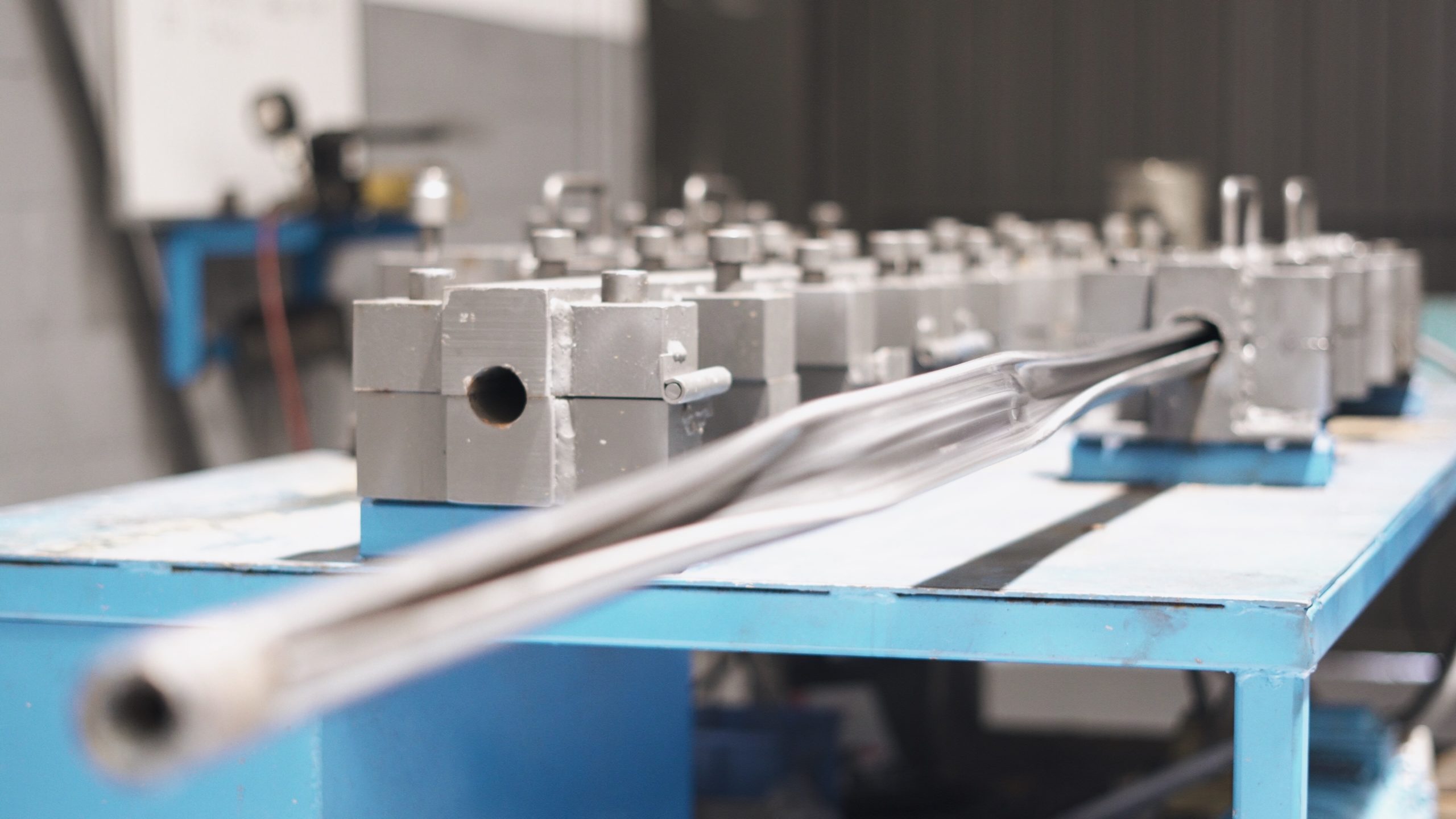
Elastic modulus and related properties
The relationship between applied force and deformation is governed by the longitudinal elastic modulus, known as Young’s modulus. It is a material constant that describes how much a material deforms under tensile stress along its axis. A higher Young’s modulus means the material is stiffer and deforms less under a given load.
Equally relevant is the transverse elastic modulus, or shear modulus, since the forces a rock mass exerts on a bolt are not purely axial. Many of these forces act transversally. For isotropic materials, the shear modulus has a fixed relationship with Young’s modulus and Poisson’s ratio.
Necking: the final stage before failure/strong>
One more concept worth understanding is necking. Once the yield point is passed and plastic deformation begins, a localized reduction of the cross-section occurs in the zone where the bolt will eventually break. This progressive reduction continues until fracture. Necking is a phenomenon that takes place in the plastic range of the steel and is an indicator that the material is approaching failure.
What this means in practice
Breaking load is not the only thing that matters when selecting a bolt. Two bolts with identical breaking loads can perform very differently in real conditions, particularly in ground that generates dynamic events or tangential stresses. For expansion bolts, where the steel is loaded through pressure and material deformation during installation, steel quality plays an especially critical role.
At ONIX Underground, we engineer our bolts to deliver high performance across all loading conditions.
Our EMC Expandable Rock Bolts are manufactured with a yield strength above 80% of the breaking load and an elongation typically above 20%. This combination gives the bolt exceptional behavior in dynamic ground conditions and environments with shear forces, absorbing stress without reaching plastic deformation or fracture.
So next time you are evaluating a bolt, look beyond the breaking load figure. Two bolts that share the same breaking load can behave entirely differently in the field. Yield strength, elongation, and material quality are not secondary details. In many conditions, they are the deciding factors in safety.
